Question 1 of 10
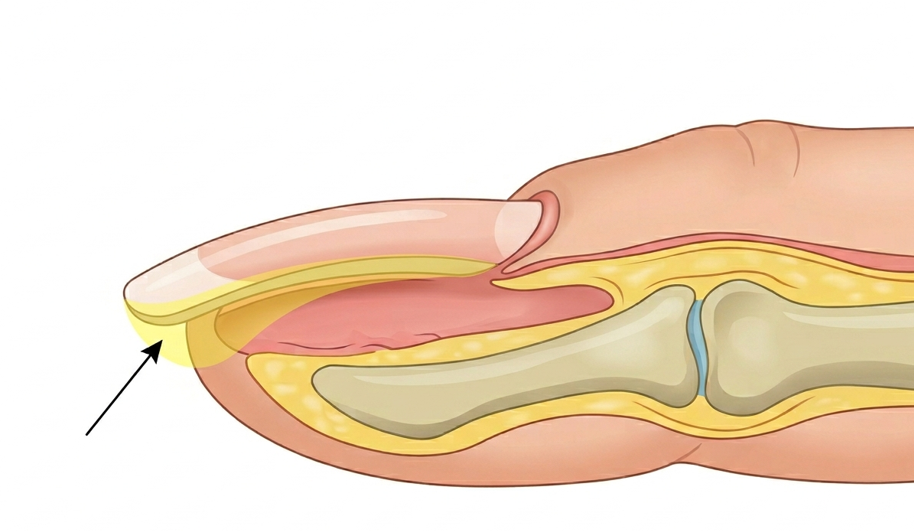
The region highlighted in yellow under the free edge of the nail is called the:
Vùng được tô vàng dưới cạnh tự do của móng được gọi là:
A Matrix Matrix (mầm móng)
B Cuticle Lớp biểu bì móng
C Hyponychium Hyponychium (dưới cạnh tự do)
D Free edge Cạnh tự do (free edge)
Explanation
The hyponychium is the thickened skin underneath the free edge of the nail. It forms a protective seal that blocks bacteria and debris from entering under the nail plate.
Hyponychium là vùng da dày dưới cạnh tự do của móng. Nó tạo một lớp niêm phong bảo vệ ngăn vi khuẩn và bụi bẩn xâm nhập dưới lámina móng.
Question 2 of 10
A whirlpool foot spa must be cleaned and disinfected:
Bồn ngâm chân xoáy nước phải được làm sạch và khử trùng:
A After each client Sau mỗi khách
B Once a week Một lần mỗi tuần
C Once a day at closing Một lần mỗi ngày khi đóng cửa
D Only when visibly dirty Chỉ khi nhìn thấy bẩn
Explanation
Texas TDLR requires foot spas to be cleaned and disinfected after EVERY client, with a more thorough weekly disinfection and a documented log.
TDLR Texas yêu cầu bồn ngâm chân phải được làm sạch và khử trùng sau MỖI khách, kèm khử trùng kỹ lưỡng hàng tuần và sổ ghi chép.
Question 3 of 10
What is the most effective way to prevent the spread of infection in a nail salon?
Cách hiệu quả nhất để ngăn ngừa lây lan nhiễm trùng trong tiệm móng là gì?
A Wearing latex gloves at all times Đeo găng tay latex mọi lúc
B Using antibacterial sprays Sử dụng bình xịt kháng khuẩn
C Hand washing with soap and water Rửa tay bằng xà phòng và nước
D Wiping tools with alcohol pads Lau dụng cụ bằng miếng cồn
Explanation
Frequent and thorough hand washing is universally recognized as the single most effective infection-control measure. Gloves and disinfectants are supplements, not substitutes.
Rửa tay thường xuyên và kỹ lưỡng được công nhận rộng rãi là biện pháp kiểm soát nhiễm trùng hiệu quả nhất. Găng tay và chất khử trùng chỉ là biện pháp bổ sung, không thể thay thế.
Question 4 of 10
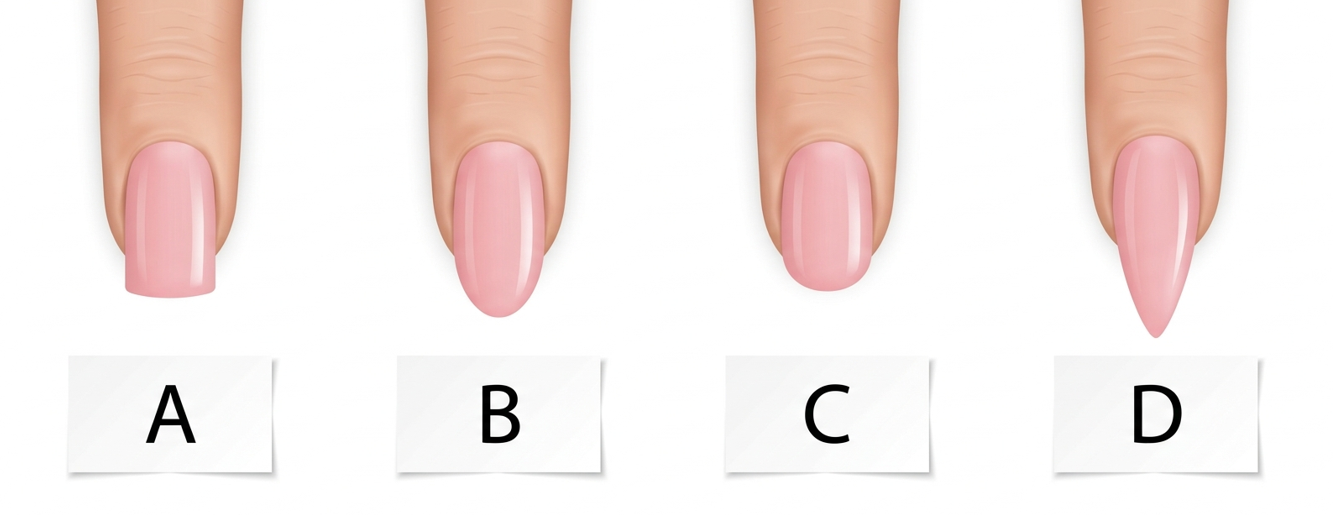
A client wants the strongest natural nail shape for daily typing work. Which shape is the WORST choice?
Một khách hàng muốn hình dáng móng tự nhiên chắc nhất cho công việc đánh máy hàng ngày. Hình dạng nào là lựa chọn TỆ NHẤT?
A C (round) C (tròn)
B A (square) A (vuông)
C B (oval)
D D (stiletto / pointed) D (stiletto / nhọn)
Explanation
Stiletto/pointed shapes (D) are the most fragile because most of the nail extends past the support of the nail bed and the narrow point concentrates stress. For a typist or client doing daily manual work, stiletto natural nails will chip, split, or break constantly. Suggest an oval or short squoval instead.
Hình dạng stiletto/nhọn (D) dễ gãy nhất vì phần lớn móng nhô ra khỏi sự hỗ trợ của giường móng và đầu nhọn tập trung lực. Với người đánh máy hoặc khách làm việc tay hàng ngày, móng tự nhiên stiletto sẽ liên tục mẻ, nứt hoặc gãy. Hãy gợi ý hình oval hoặc squoval ngắn.
Question 5 of 10
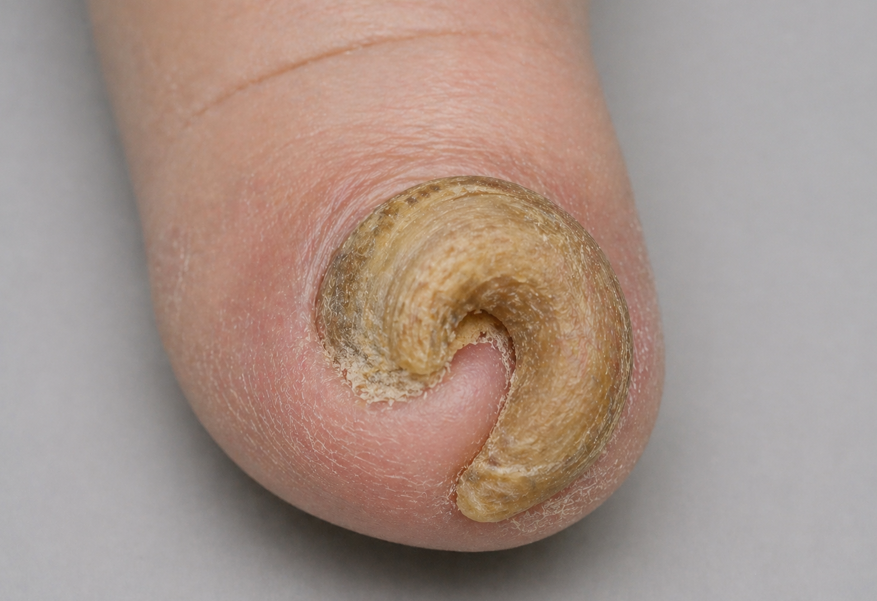
This severely thickened, curled, ram's-horn-shaped toenail condition is called:
Tình trạng móng chân dày sừng nặng, cong queo như sừng cừu này được gọi là:
A Onycholysis Onycholysis (bong móng)
B Onychogryphosis Onychogryphosis (móng dày sừng)
C Koilonychia Koilonychia (móng hình thìa)
D Onychomycosis Onychomycosis (nấm móng)
Explanation
Onychogryphosis ("ram's horn nail") is severe nail thickening and curvature, most often on the big toe. Causes include long-term neglect, trauma, or poor circulation in elderly clients. Refer to a podiatrist — do NOT attempt to file or cut down in the salon.
Onychogryphosis ("móng sừng cừu") là hiện tượng móng dày sừng và cong rất nặng, thường ở ngón chân cái. Nguyên nhân gồm bỏ bê lâu ngày, chấn thương hoặc tuần hoàn kém ở người cao tuổi. Giới thiệu đến bác sĩ chuyên khoa chân — KHÔNG được giũa hoặc cắt ở tiệm.
Question 6 of 10
MMA (methyl methacrylate) is:
MMA (methyl methacrylate) là:
A The current standard for safe nail enhancements Tiêu chuẩn hiện tại cho móng giả an toàn
B Only allowed for pedicures Chỉ được phép dùng cho pedicure
C A type of UV gel Một loại gel UV
D Banned by most state boards including Texas TDLR for nail use Bị hầu hết các hội đồng tiểu bang bao gồm TDLR Texas cấm sử dụng cho móng
Explanation
MMA causes severe allergic reactions, nail damage, and is extremely difficult to remove. EMA (ethyl methacrylate) is the legal alternative. Use of MMA can cost you your license.
MMA gây phản ứng dị ứng nghiêm trọng, tổn thương móng và rất khó loại bỏ. EMA (ethyl methacrylate) là lựa chọn thay thế hợp pháp. Sử dụng MMA có thể khiến bạn mất giấy phép.
Question 7 of 10
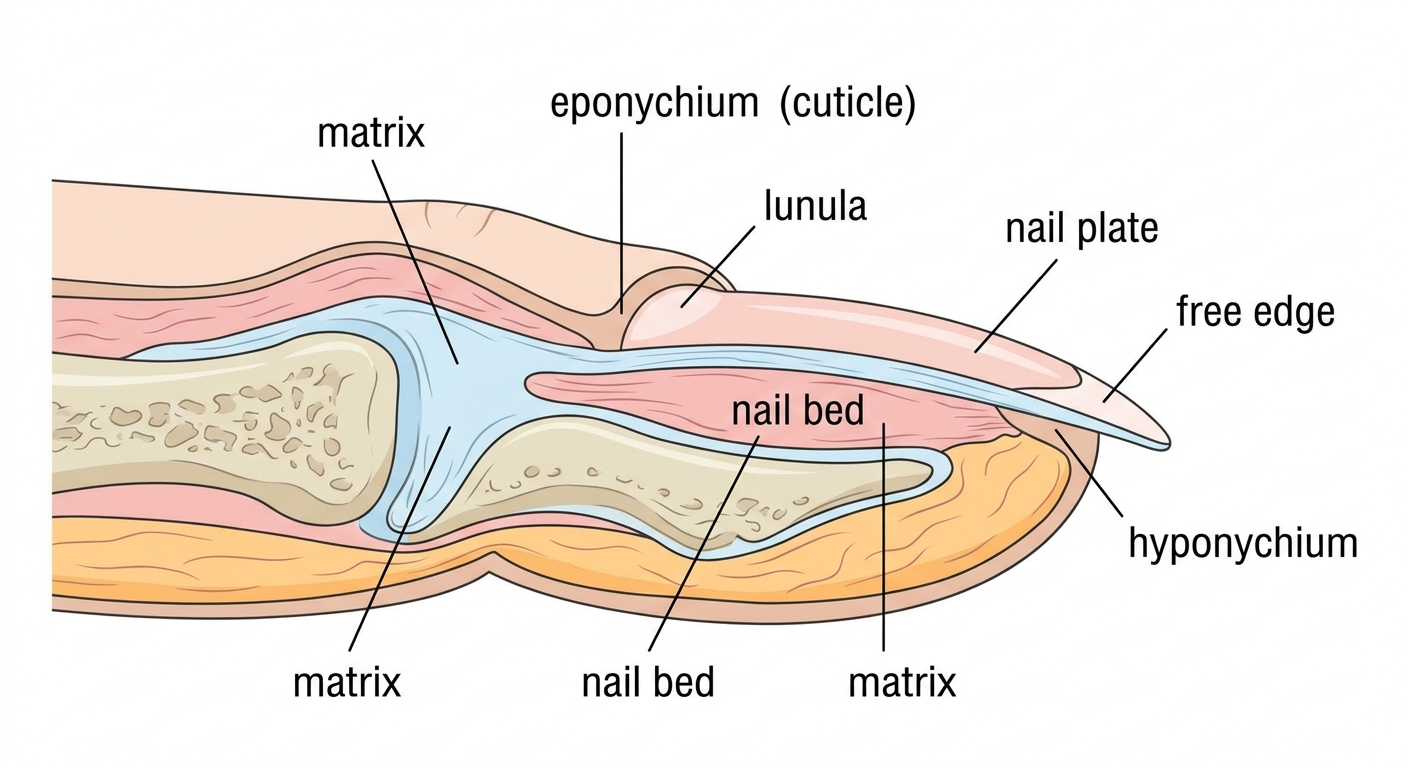
In the cross-section illustration above, which structure is responsible for producing new nail cells?
Trong hình minh họa cắt ngang ở trên, cấu trúc nào chịu trách nhiệm tạo ra tế bào móng mới?
A Nail bed Giường móng (nail bed)
B Free edge Cạnh tự do (free edge)
C Hyponychium Hyponychium (dưới cạnh tự do)
D Matrix Matrix (mầm móng)
Explanation
The matrix is the active cell-producing tissue at the base of the nail. Damage here can permanently deform the nail.
Matrix là mô hoạt động sản sinh tế bào ở gốc móng. Tổn thương ở đây có thể làm móng biến dạng vĩnh viễn.
Question 8 of 10
Looking at the polish stroke diagram, in what order should the three strokes be applied for an even coat?
Nhìn vào sơ đồ ba nét sơn, ba nét nên được sơn theo thứ tự nào để có lớp đều?
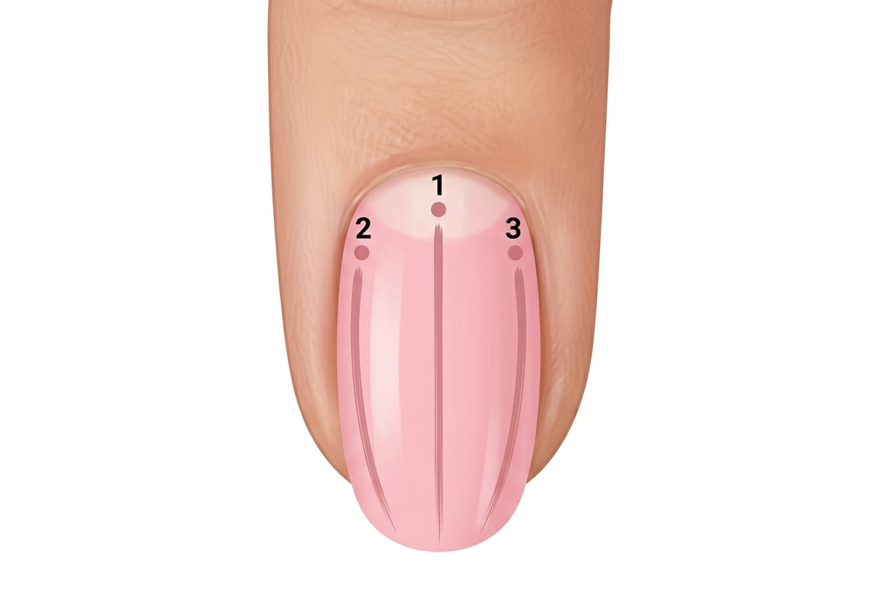
A 2 → 1 → 3 (left side, then center, then right) 2 → 1 → 3 (trái, giữa, phải)
B Random — order does not matter Tùy ý — thứ tự không quan trọng
C 1 → 2 → 3 (center first, then both sides) 1 → 2 → 3 (giữa trước, sau đó hai bên)
D 1 → 3 → 2 (center, right, then left) 1 → 3 → 2 (giữa, phải, trái)
Explanation
Standard 3-stroke technique: load the brush, place it just above the cuticle in the CENTER of the nail (stroke 1), then sweep down each SIDE (strokes 2 and 3). Center first ensures the most polish lands on the visual focal point and the sides blend into it for an even, professional finish.
Kỹ thuật 3 nét chuẩn: lấy sơn vào cọ, đặt ngay trên biểu bì ở GIỮA móng (nét 1), sau đó kéo xuống mỗi BÊN (nét 2 và 3). Giữa trước giúp sơn tập trung vào điểm trọng tâm thị giác, và hai bên hòa vào tạo lớp sơn đều, chuyên nghiệp.
Question 9 of 10
The condition shown — separation of the nail plate from the nail bed starting at the free edge — is called:
Tình trạng trong ảnh — lámina móng tách khỏi giường móng bắt đầu từ cạnh tự do — được gọi là:
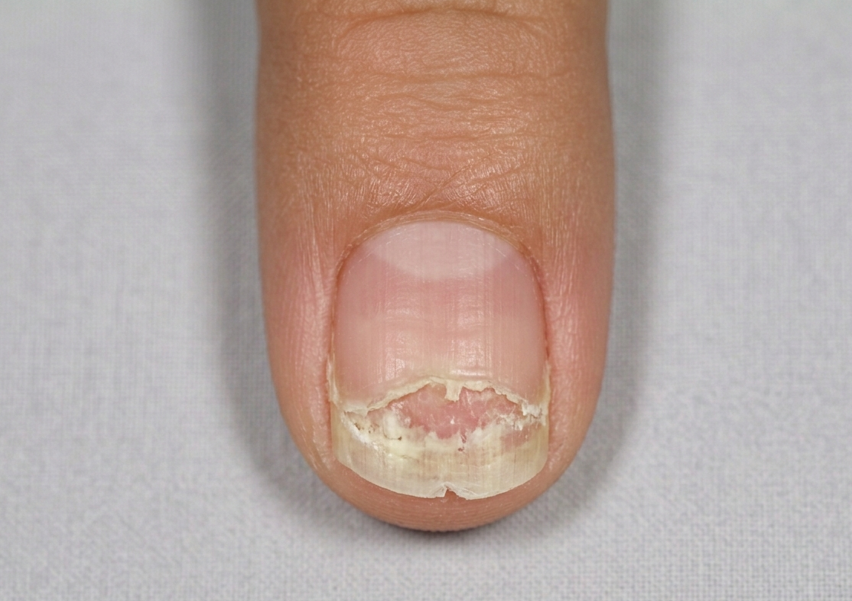
A Onychorrhexis Móng gãy dọc (onychorrhexis)
B Onychogryphosis Móng dày sừng (onychogryphosis)
C Onycholysis Bong móng (onycholysis)
D Onychocryptosis Móng quặp (onychocryptosis)
Explanation
Onycholysis is the painless separation of the nail plate from the bed (without shedding). Causes include trauma, fungal infection, certain medications, or chemicals. Suspicious cases — especially with discoloration — should be referred to a doctor.
Onycholysis là sự tách lámina móng khỏi giường móng không đau (không rụng). Nguyên nhân gồm chấn thương, nấm, một số thuốc hoặc hóa chất. Trường hợp nghi ngờ — đặc biệt có đổi màu — nên giới thiệu đến bác sĩ.
Question 10 of 10
California nail technician licenses are issued by:
Giấy phép kỹ thuật viên móng California được cấp bởi:
A Local city government Chính quyền địa phương
B Texas Department of Licensing and Regulation TDLR Texas
C US Department of Labor Bộ Lao động Hoa Kỳ
D California Board of Barbering and Cosmetology (BBC) Hội đồng Cắt tóc và Thẩm mỹ California (BBC)
Explanation
California licenses cosmetology, barbering, and manicuring through the Board of Barbering and Cosmetology (BBC), part of the California Department of Consumer Affairs.
California cấp phép thẩm mỹ, cắt tóc và làm móng qua Hội đồng BBC, thuộc Sở Bảo vệ Người tiêu dùng California.