Question 1 of 10
What is the most effective way to prevent the spread of infection in a nail salon?
¿Cuál es la forma más efectiva de prevenir la propagación de infecciones en un salón de uñas?
A Hand washing with soap and water Lavarse las manos con agua y jabón
B Wearing latex gloves at all times Usar guantes de látex en todo momento
C Using antibacterial sprays Usar aerosoles antibacterianos
D Wiping tools with alcohol pads Limpiar las herramientas con almohadillas de alcohol
Explanation
Frequent and thorough hand washing is universally recognized as the single most effective infection-control measure. Gloves and disinfectants are supplements, not substitutes.
El lavado frecuente y completo de manos es reconocido universalmente como la medida más efectiva para el control de infecciones. Los guantes y desinfectantes son complementos, no sustitutos.
Question 2 of 10
The region highlighted in yellow under the free edge of the nail is called the:
La región resaltada en amarillo debajo del borde libre de la uña se llama:
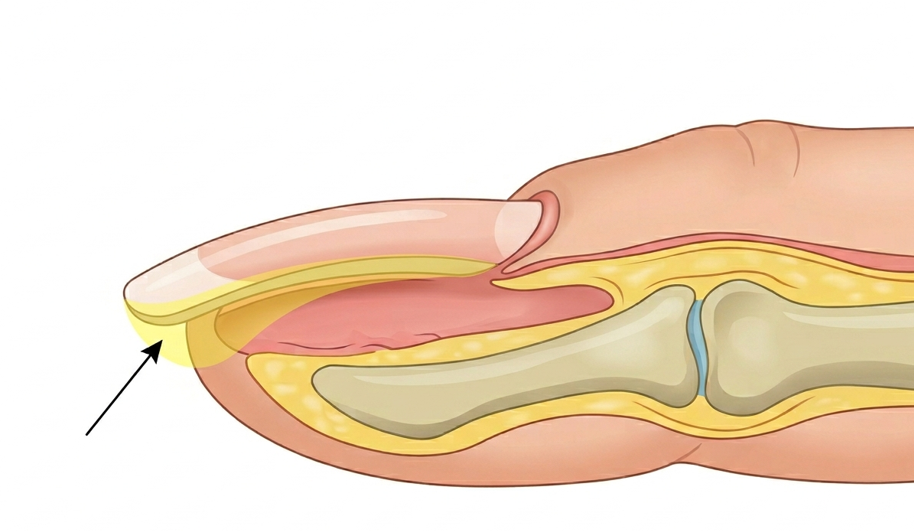
A Free edge Borde libre
B Cuticle Cutícula
C Matrix Matriz
D Hyponychium Hiponiquio
Explanation
The hyponychium is the thickened skin underneath the free edge of the nail. It forms a protective seal that blocks bacteria and debris from entering under the nail plate.
El hiponiquio es la piel engrosada debajo del borde libre de la uña. Forma un sello protector que bloquea bacterias y residuos de entrar bajo la lámina ungueal.
Question 3 of 10
In the cross-section illustration above, which structure is responsible for producing new nail cells?
En la ilustración de corte transversal de arriba, ¿qué estructura es responsable de producir nuevas células de la uña?
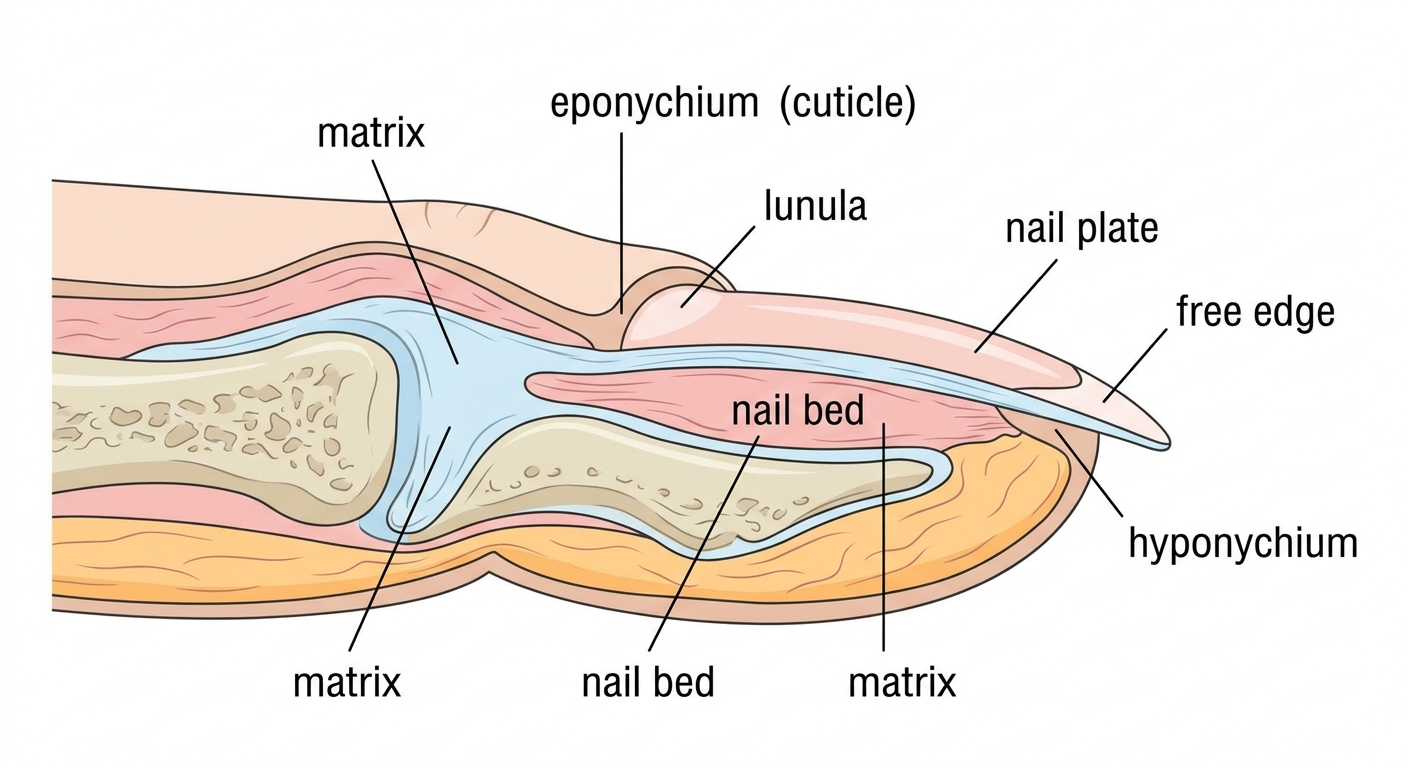
A Matrix Matriz
B Hyponychium Hiponiquio
C Nail bed Lecho ungueal
D Free edge Borde libre
Explanation
The matrix is the active cell-producing tissue at the base of the nail. Damage here can permanently deform the nail.
La matriz es el tejido activo productor de células en la base de la uña. Un daño aquí puede deformar la uña permanentemente.
Question 4 of 10
MMA (methyl methacrylate) is:
El MMA (metil metacrilato) es:
A Only allowed for pedicures Permitido solo para pedicuras
B Banned by most state boards including Texas TDLR for nail use Prohibido por la mayoría de las juntas estatales incluyendo TDLR de Texas para uso en uñas
C A type of UV gel Un tipo de gel UV
D The current standard for safe nail enhancements El estándar actual para uñas postizas seguras
Explanation
MMA causes severe allergic reactions, nail damage, and is extremely difficult to remove. EMA (ethyl methacrylate) is the legal alternative. Use of MMA can cost you your license.
El MMA causa reacciones alérgicas severas, daño a las uñas y es extremadamente difícil de remover. El EMA (etil metacrilato) es la alternativa legal. El uso de MMA puede costarle su licencia.
Question 5 of 10
Looking at the polish stroke diagram, in what order should the three strokes be applied for an even coat?
Mirando el diagrama de pinceladas de esmalte, ¿en qué orden deben aplicarse las tres pinceladas para una capa uniforme?
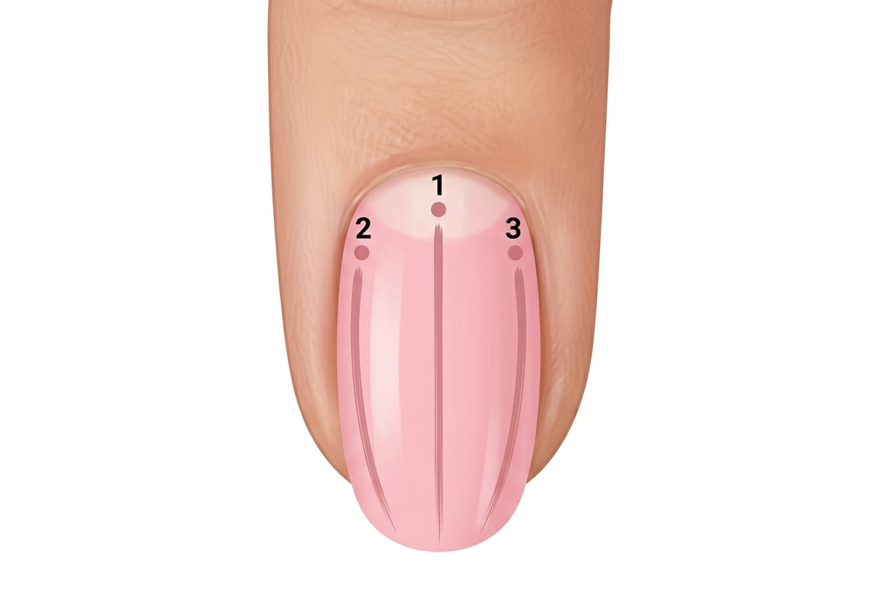
A 1 → 2 → 3 (center first, then both sides) 1 → 2 → 3 (primero el centro, luego ambos lados)
B 2 → 1 → 3 (left side, then center, then right) 2 → 1 → 3 (izquierda, centro, derecha)
C 1 → 3 → 2 (center, right, then left) 1 → 3 → 2 (centro, derecha, izquierda)
D Random — order does not matter Al azar — el orden no importa
Explanation
Standard 3-stroke technique: load the brush, place it just above the cuticle in the CENTER of the nail (stroke 1), then sweep down each SIDE (strokes 2 and 3). Center first ensures the most polish lands on the visual focal point and the sides blend into it for an even, professional finish.
Técnica estándar de 3 pinceladas: carga el pincel, colócalo justo encima de la cutícula en el CENTRO de la uña (pincelada 1), luego desliza por cada LADO (pinceladas 2 y 3). El centro primero asegura que la mayor cantidad de esmalte caiga en el punto focal y los lados se mezclen para un acabado uniforme y profesional.
Question 6 of 10
A whirlpool foot spa must be cleaned and disinfected:
Un spa de pies con hidromasaje debe limpiarse y desinfectarse:
A Once a week Una vez a la semana
B After each client Después de cada cliente
C Once a day at closing Una vez al día al cerrar
D Only when visibly dirty Solo cuando esté visiblemente sucio
Explanation
Texas TDLR requires foot spas to be cleaned and disinfected after EVERY client, with a more thorough weekly disinfection and a documented log.
TDLR de Texas exige que los spas de pies se limpien y desinfecten después de CADA cliente, con una desinfección semanal más profunda y un registro documentado.
Question 7 of 10
Texas nail technician licenses are issued by:
Las licencias de técnico en uñas de Texas son emitidas por:
A Texas Board of Cosmetology Junta de Cosmetología de Texas
B US Department of Labor Departamento de Trabajo de EE.UU.
C Local city government Gobierno municipal local
D Texas Department of Licensing and Regulation (TDLR) Departamento de Licencias y Regulación de Texas (TDLR)
Explanation
Since 2017, all cosmetology and barbering licenses in Texas — including Manicurist (Nail Technician) — are issued and regulated by TDLR. The former Texas Cosmetology Commission was abolished.
Desde 2017, todas las licencias de cosmetología y barbería en Texas — incluyendo Manicurista (Técnico en Uñas) — son emitidas y reguladas por TDLR. La antigua Comisión de Cosmetología de Texas fue abolida.
Question 8 of 10
A client wants the strongest natural nail shape for daily typing work. Which shape is the WORST choice?
Una clienta quiere la forma de uña natural más resistente para trabajo diario de escritura. ¿Cuál forma es la PEOR elección?
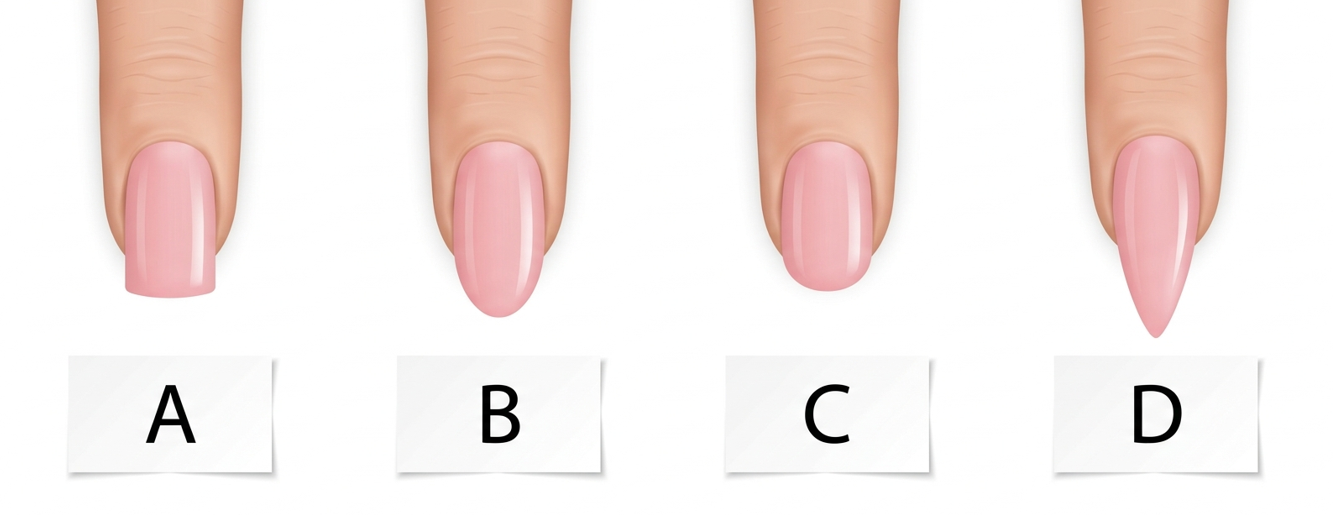
A C (round) C (redonda)
B D (stiletto / pointed) D (stiletto / puntiaguda)
C A (square) A (cuadrada)
D B (oval)
Explanation
Stiletto/pointed shapes (D) are the most fragile because most of the nail extends past the support of the nail bed and the narrow point concentrates stress. For a typist or client doing daily manual work, stiletto natural nails will chip, split, or break constantly. Suggest an oval or short squoval instead.
Las formas stiletto/puntiagudas (D) son las más frágiles porque la mayor parte de la uña sobresale del soporte del lecho ungueal y la punta estrecha concentra el estrés. Para una mecanógrafa o cliente con trabajo manual diario, las uñas naturales stiletto se astillarán, rajarán o romperán constantemente. Sugiere oval o squoval corta.
Question 9 of 10
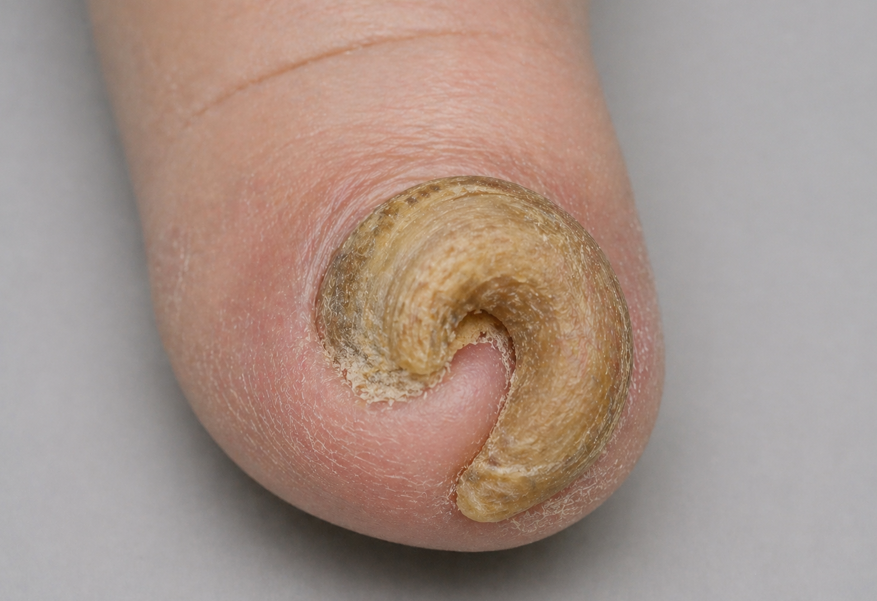
This severely thickened, curled, ram's-horn-shaped toenail condition is called:
Esta condición de uña del pie severamente engrosada y curvada en forma de cuerno de carnero se llama:
A Onychomycosis Onicomicosis
B Onychogryphosis Onicogrifosis
C Koilonychia Koiloniquia
D Onycholysis Onicólisis
Explanation
Onychogryphosis ("ram's horn nail") is severe nail thickening and curvature, most often on the big toe. Causes include long-term neglect, trauma, or poor circulation in elderly clients. Refer to a podiatrist — do NOT attempt to file or cut down in the salon.
La onicogrifosis ("uña en cuerno de carnero") es un engrosamiento severo y curvatura de la uña, más frecuente en el dedo gordo del pie. Causas incluyen abandono prolongado, trauma o mala circulación en clientes mayores. Refiera a un podólogo — NO intente limar ni cortar en el salón.
Question 10 of 10
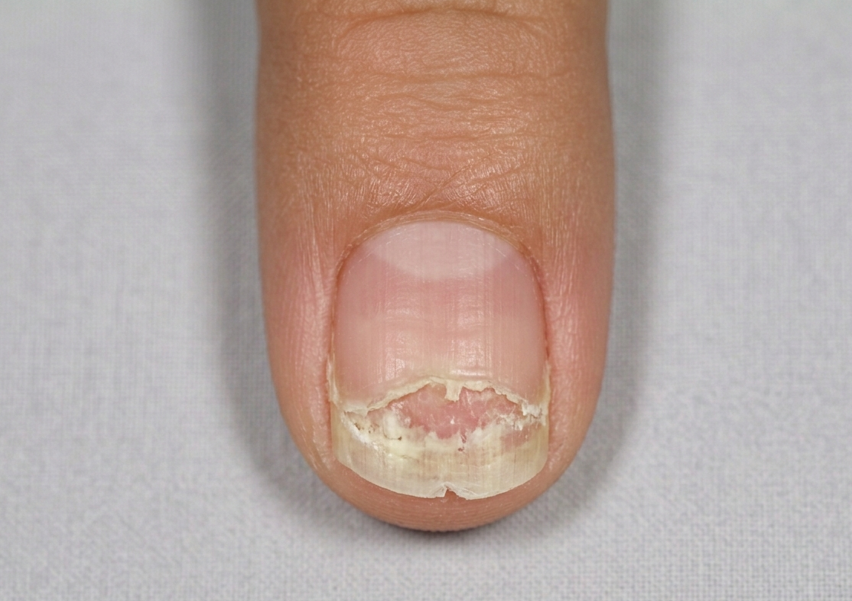
The condition shown — separation of the nail plate from the nail bed starting at the free edge — is called:
La condición mostrada — separación de la lámina ungueal del lecho ungueal comenzando en el borde libre — se llama:
A Onychorrhexis Oniquia rexis
B Onychocryptosis Onicocriptosis
C Onychogryphosis Onicogrifosis
D Onycholysis Onicólisis
Explanation
Onycholysis is the painless separation of the nail plate from the bed (without shedding). Causes include trauma, fungal infection, certain medications, or chemicals. Suspicious cases — especially with discoloration — should be referred to a doctor.
La onicólisis es la separación indolora de la lámina ungueal del lecho (sin caída). Las causas incluyen trauma, infección fúngica, ciertos medicamentos o químicos. Casos sospechosos — especialmente con decoloración — deben referirse al médico.